Choosing the right Dust Cyclone is not simply a matter of selecting the largest model. It requires matching airflow, particle size, material density, pressure loss, and available space. A cyclone that performs well in a woodworking shop may struggle with fine mineral dust. The details matter.
The U.S. Environmental Protection Agency’s Air Pollution Control Cost Manual reports typical cyclone collection efficiencies of approximately 70–95%, depending on particle size and operating conditions. EPA AP-42 guidance also indicates that larger particles are collected more effectively than particles below 10 micrometers. That difference becomes visible in practice: heavy chips may fall cleanly into the hopper, while fine dust can remain suspended near a filter inlet. ACGIH’s Industrial Ventilation guidance further stresses correct duct velocity, balanced airflow, and suitable hood design. A powerful cyclone cannot repair a poorly designed system.
C. J. Stairmand, a leading cyclone-separator researcher, emphasized a practical principle: cyclone performance depends on design proportions, not appearance alone. His work still supports modern equipment selection. Check the inlet diameter, cone length, vortex finder, pressure drop, and dust discharge system. Also examine whether the supplier provides test data, not only impressive claims. A unit rated for 5,000 cubic feet per minute may underperform if the connected ductwork creates excessive resistance. Bigger is not always better. Sometimes, the honest answer is less convenient. The best Dust Cyclone is the one that consistently protects process efficiency, reduces filter loading, and suits the actual dust—not the specification sheet.
How to Choose the Right Dust Cyclone for Your Business?
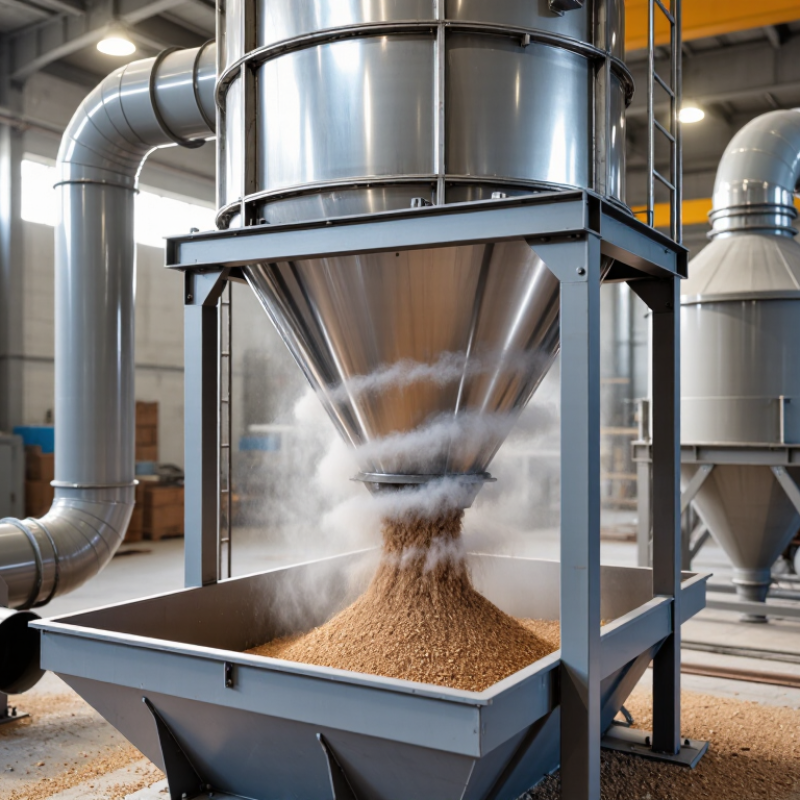
A dust cyclone separates airborne particles by spinning contaminated air inside a cone-shaped chamber. The inlet creates a vortex, forcing heavier particles toward the wall. Gravity then moves them into a collection hopper. Cleaner air reverses direction and exits through the central outlet. No filter fabric is involved. That makes cyclones useful as pre-cleaners for sawdust, grain dust, mineral particles, and metal shavings.
Particle size matters greatly. The U.S. Environmental Protection Agency’s Air Pollution Control Cost Manual reports typical cyclone collection efficiencies of about 70–95%, while high-efficiency designs may reach 90–99% under suitable conditions. These figures can look impressive. They can also mislead. Fine particles below roughly 10 micrometers are harder to capture, especially when airflow changes. A cyclone should therefore be selected using measured airflow, particle density, moisture, temperature, and target particle size. Guessing from motor horsepower is a common mistake.
Pressure drop affects operating cost. EPA guidance identifies cyclone pressure drops commonly around 0.5–2.0 kPa, depending on design and velocity. Higher velocity may improve separation, but it can increase noise, wear, and energy use. NFPA 652 also emphasizes managing combustible dust hazards through system design and housekeeping. Check the hopper seal, duct velocity, access points, and discharge method. Small leaks can disturb the vortex. Sometimes, the best choice is not the largest cyclone. It is the one matched to real dust behavior, measured airflow, and the limits of the entire extraction system.
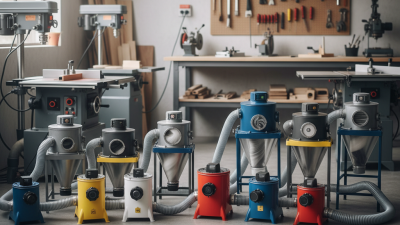
Choosing a dust cyclone begins with the material, not the equipment catalog. Measure the dust.
Record particle size, moisture, temperature, and bulk density before comparing specifications. Fine, dry particles may require a different design than heavy wood chips or abrasive mineral dust. A cyclone’s airflow rating must match the actual process demand, usually measured in cubic meters per hour or cubic feet per minute. Oversizing can reduce separation efficiency, while undersizing may create excessive pressure loss.
Check the inlet diameter, body diameter, cone length, and expected pressure drop. These dimensions influence air velocity and collection performance. Ask for tested efficiency at your operating airflow, not only a general percentage. Small details matter. The dust outlet must also fit your hopper, rotary valve, or collection container without leakage. For hot or abrasive dust, confirm the shell material, lining, temperature range, and wear resistance. Conductive construction and suitable grounding may be necessary in certain dusty environments, according to qualified safety professionals and local requirements.
Real installations often expose weaknesses that calculations miss. Inspect available space, duct bends, fan capacity, and cleaning access before ordering. A larger cyclone is not always better. I have seen systems lose performance because the inlet duct was too narrow or sharply angled. That mistake is easy to overlook. Treat supplier drawings, performance data, and site measurements as separate checks. If the dust changes during production, select specifications with a controlled operating margin rather than guessing. Test samples when possible, because laboratory results may not represent your actual moisture, particle shape, or loading conditions.
Choosing a dust cyclone starts with the material, not the catalog. In practical field evaluations, operators often begin with airflow alone. That shortcut can mislead. Record dust type, particle size, bulk density, moisture, temperature, and production rate. A wood shop producing fine sanding dust needs different separation behavior than a mineral process. Specify normal and peak airflow in cubic meters per hour. Include leakage and future capacity. A neat number is rarely enough.
Pressure drop is the fan’s workload. Check the cyclone’s rated drop at your actual airflow, not a nominal test point. Measure pressure before the inlet and after the outlet, using calibrated gauges. Keep duct length, elbows, filters, and discharge equipment in the calculation. A cyclone may collect well but starve the fan. Watch the fan curve. If airflow falls, collection can deteriorate quickly. I once trusted a clean installation drawing and ignored a clogged prefilter. The result was disappointing, and preventable. This is where experience needs humility.
Collection efficiency should be expressed by particle size. Ask whether the target is coarse chips, respirable fines, or both. A single overall percentage can hide weak fine-particle performance. Compare inlet and outlet dust samples under steady operating conditions. Check pressure drop again after several hours, when dust buildup changes resistance. Inspect the hopper seal, because air entering below the cyclone can disturb separation. Use documented test methods and keep operating records. Real performance is often less perfect than the specification. That gap deserves investigation, not excuses.
Airflow, Pressure Drop, and Collection Efficiency at Representative Operating Points
A suitable cyclone should provide the required airflow without creating excessive pressure loss. Higher-efficiency designs generally require greater pressure drop, while collection efficiency also depends strongly on particle size, dust loading, inlet velocity, and cyclone geometry. These representative operating points are intended for preliminary comparison; final selection should be verified against the supplier’s performance data and process conditions.
Choosing the right dust cyclone begins with the dust itself, not the equipment catalogue. Measure particle size, moisture, temperature, density, and expected airflow. Fine particles need a different inlet design than heavy chips. A poorly matched body can waste pressure and still release visible dust.
Cyclone geometry controls performance. Compare inlet velocity, cone length, outlet diameter, and pressure drop. A high-efficiency design may capture smaller particles, but it can demand more fan power. In a plant review, I would check airflow at peak production, not only during a quiet shift. Real conditions are often messier. Duct leaks, changing moisture, and irregular feeding can reduce practical efficiency.
Material selection deserves equal attention. Carbon steel suits many dry, moderate-temperature applications and keeps costs controlled. Stainless steel is safer for humid or corrosive streams. Abrasive minerals may require replaceable liners around the inlet and cone. For hot gas, confirm the material’s temperature limits, weld quality, and thermal expansion behavior. Do not rely on a coating alone where particles strike at high speed.
Ask for test data based on your actual dust loading. If possible, inspect similar installations and measure outlet emissions after several weeks. I have seen a technically impressive cyclone underperform because its discharge valve leaked. The design was sound. The installation was not. That detail should influence the final specification.
| Cyclone Design | Typical Dust or Application | Particle-Size Focus | Relative Collection Performance | Typical Pressure-Drop Profile | Recommended Construction Materials | Key Selection Considerations |
|---|---|---|---|---|---|---|
| Standard single-stage cyclone | General-purpose removal of coarse dust from woodworking, grain handling, mineral processing, and material conveying | Most effective for particles above approximately 10–20 μm; performance decreases as particles become finer | Good removal of coarse and medium particles when correctly sized and operated | Moderate; commonly selected when energy use and dust separation must be balanced | Carbon steel for dry, non-corrosive dust; galvanized or stainless steel where corrosion resistance is required | Confirm airflow, inlet velocity, available space, dust abrasiveness, and the required outlet-air quality |
| High-efficiency cyclone | Fine industrial dust pre-separation before a baghouse, cartridge collector, or other final-stage filter | Designed to improve separation of smaller particles, often in the low-micrometre range depending on geometry and operating conditions | Higher fine-particle collection than a standard cyclone, but not a substitute for a properly selected final filter when strict emission limits apply | Higher than a standard cyclone because of increased gas velocity and more intensive particle separation | Wear-resistant carbon steel, abrasion-resistant liners, or stainless steel for corrosive streams | Use when preloading the final filter is a concern; verify fan capacity, temperature, and allowable pressure loss |
| Multi-cyclone collector | Large-volume air streams in boilers, process plants, combustion systems, and bulk-material operations | Small-diameter cyclone tubes improve separation of fine and medium particles compared with one large cyclone | Good capacity and relatively consistent performance across a broad airflow range when tubes are evenly loaded | Moderate to high; depends on tube diameter, quantity, inlet velocity, and arrangement | Carbon steel housing with replaceable wear liners; stainless steel or coated components for corrosive service | Requires uniform gas distribution, accessible cleanout areas, and protection against plugging of individual tubes |
| High-temperature cyclone | Hot flue gas, kiln exhaust, furnace service, thermal processing, and high-temperature material conveying | Selected primarily for hot-gas particle separation; actual cut size depends on design and operating conditions | Suitable for coarse and medium particles at temperatures that may exceed the limits of many fabric filters | Moderate to high, with thermal expansion and gas-density changes affecting system performance | Heat-resistant carbon steel, stainless steel, refractory lining, or ceramic lining as required by temperature and abrasion | Specify continuous and peak temperature, thermal cycling, expansion allowance, insulation, and downstream equipment limits |
| Abrasion-resistant cyclone | Sand, cement, minerals, fly ash, foundry dust, glass particles, and other erosive solids | Coarse and medium abrasive particles; separation performance depends on cyclone geometry and solids loading | Good dust separation with improved service life in high-solids applications when wear zones are protected | Moderate to high; higher velocity can improve separation but may accelerate erosion | Thick carbon steel, abrasion-resistant plate, replaceable ceramic sections, or cast wear liners | Protect the inlet, cone, and lower body first; consider replaceable liners and inspection ports for maintenance planning |
| Corrosion-resistant cyclone | Moist, acidic, alkaline, saline, or chemically reactive process gases | Particle-size performance is determined by the cyclone design; material choice addresses chemical exposure rather than efficiency | Comparable to the selected cyclone geometry, provided corrosion does not alter the internal surface or cause leakage | Depends on the selected design; internal roughness and deposits can increase pressure loss over time | Stainless steel, fiberglass-reinforced plastic, coated steel, or other chemically compatible materials | Review gas composition, moisture, dew point, chloride content, chemical concentration, and compatibility of joints and coatings |
| Wet cyclone or cyclone scrubber | Dust streams where cooling, gas conditioning, or simultaneous particle and soluble-gas control is needed | Can capture fine particles more effectively than a dry cyclone when liquid contact is properly designed | Potentially high for fine particulate matter, but results depend on liquid-to-gas ratio, droplet formation, and separator design | Moderate to high, with additional losses from liquid injection and droplet separation | Stainless steel, fiberglass-reinforced plastic, rubber-lined steel, or other wet-service materials | Plan for wastewater treatment, corrosion control, nozzle maintenance, freezing protection, and mist elimination |
| Spark-resistant cyclone system | Combustible dust from woodworking, food processing, agricultural products, and similar operations | Usually intended for coarse and medium dust removal upstream of a filter or other collector | Effective as a pre-separator, but it does not by itself eliminate combustible-dust fire or explosion hazards | Design-dependent; excessive velocity can increase spark generation and erosion risk | Electrically bonded conductive metal, abrasion-resistant sections, and suitable non-sparking internal details where required | Complete a combustible-dust hazard assessment; include grounding, explosion protection, isolation, inspection, and safe dust discharge |
| Selection values are general engineering guidance rather than guaranteed performance ratings. Final sizing should be based on measured airflow, gas temperature, dust loading, particle-size distribution, moisture, bulk density, abrasiveness, corrosiveness, allowable pressure drop, and applicable local environmental and safety requirements. A cyclone is commonly used as a pre-cleaner; a downstream filter or scrubber may be necessary for fine-particle emission control. | ||||||
Installation cost is only the opening figure. The U.S. EPA Air Pollution Control Cost Manual reports typical cyclone pressure drops of about 2–6 inches water gauge. Higher pressure improves separation, but it increases fan power and operating costs.
For example, a 20,000 m³/h system at 1.2 kPa needs roughly 8 kW with an 80% efficient fan and motor. At 2,400 operating hours annually, that exceeds 19,000 kWh. Electricity prices will change the result. The calculation still exposes hidden costs.
The EPA also reports cyclone collection efficiencies commonly ranging from 70% to 95%, depending on particle size and design. Fine dust may pass through. A cheaper unit can therefore create higher filter loading and cleaning expenses.
Check inlet wear, air leaks, access doors, and dust discharge equipment during maintenance planning.
Small leaks matter.
OSHA’s Combustible Dust National Emphasis Program and current NFPA combustible-dust guidance highlight hazards from suspended dust, ignition sources, and poor housekeeping. Specify grounding, explosion protection, isolation, and safe inspection access through a documented hazard analysis.
I would not trust a quotation that lists only steel weight and airflow. Site trials, particle testing, and a realistic maintenance schedule often reveal the better investment, although predictions can still be imperfect.