2026 Best Dust Cyclone for Global Buyers and Suppliers?
In recent years, the demand for high-efficiency Dust Cyclone systems has surged globally. According to market research by Grand View Research, the dust collection systems industry is projected to reach $8.2 billion by 2025. This growth highlights the importance of effective air filtration solutions for various sectors, including manufacturing and construction.
As companies strive to enhance environmental standards, the need for advanced Dust Cyclone systems becomes critical. These systems effectively separate dust particles, improving air quality and workplace safety. However, not all systems are created equal, and selecting the right Dust Cyclone requires understanding specific needs and applications.
While many suppliers claim to offer the best options, buyers must conduct thorough research. Evaluating performance, efficiency, and maintenance costs is essential. There are instances where inferior products can lead to increased operational costs. Thus, informed decision-making is vital in this competitive market.
Overview of Dust Cyclones: Definition and Functionality
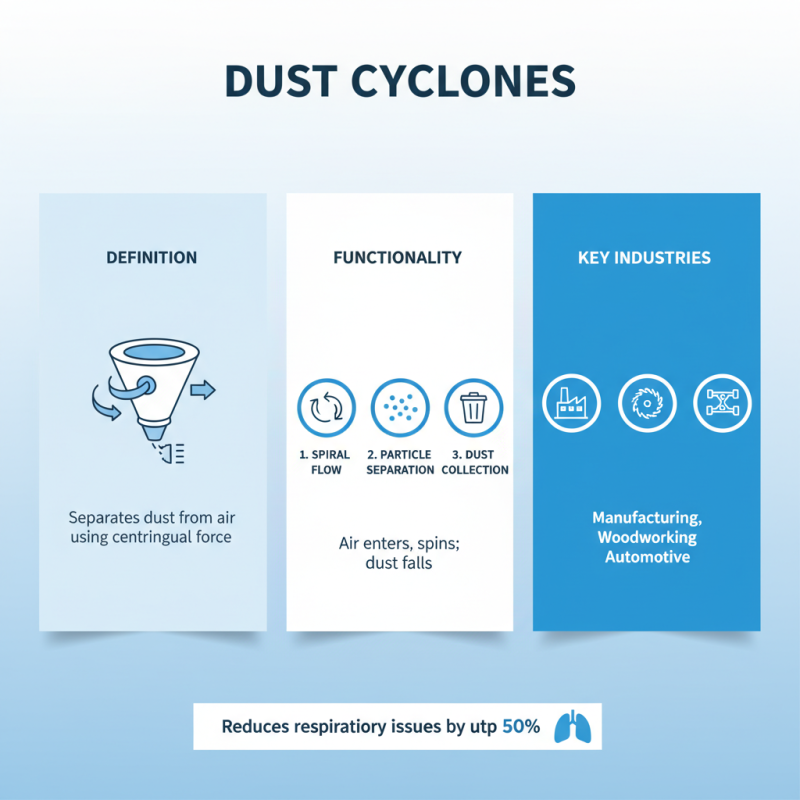
Dust cyclones are vital in various industries for efficient air filtration and dust collection. These devices operate by using centrifugal force to separate dust particles from the air. The air enters the cyclone at a tangential angle, creating a spiral flow. As a result, heavier dust particles move towards the outer wall and fall into a collection bin. This functionality is crucial in manufacturing, woodworking, and automotive industries. Reports indicate that dust control can reduce respiratory issues in industrial workers by up to 50%.
Despite their effectiveness, optimizing a dust cyclone's performance can be complex. Factors such as airflow rate, particle size, and cyclone geometry play significant roles. A report from the Institute of Dust Control estimates that 25% of dust collectors operate below optimal efficiency levels. This inefficiency can lead to increased operational costs and potential health risks for workers. Continuous monitoring and adjustments based on real-time data are essential. Regular maintenance is necessary, as even minor wear can dramatically affect performance and lead to higher emissions.
The global demand for dust cyclones continues to rise as industries prioritize sustainability and worker safety. According to the latest industry analysis, the market for air filtration systems is projected to grow by 8% annually through 2026. A reliable dust cyclone can significantly contribute to achieving these goals. However, companies must also question their current systems and consider necessary advancements. Investing in new technologies can lead to improved efficiency and reduced environmental impact.
Types of Dust Cyclones Available in 2026
In 2026, dust cyclones are essential for various industries, focusing on efficient air filtration. Different types cater to unique needs, enhancing operational efficiency.
One common type is the single-stage cyclone. It offers basic separation of dust and particles. This type is often used in smaller workshops. Performance tends to decline with increased dust load, leading to potential inefficiencies. Regular maintenance is crucial for optimal functioning.
Multi-stage cyclones offer superior dust collection. These systems can handle larger volumes of dust. They are more complex and can be costly. When properly maintained, they deliver better efficiency and lower emissions. However, their setup can be daunting for newcomers.
Choosing the right type requires careful consideration. Factors like workspace size and dust load matter. Not all systems work for every situation, creating a need for customization. Industry insights show many buyers struggle to find suitable options.
2026 Best Dust Cyclone Comparison
This chart illustrates the efficiency ratings of different types of dust cyclones available in 2026. The efficiency ratings are based on the ability to separate dust particles ranging from 0.5 to 10 microns.
Key Features and Innovations in Modern Dust Cyclones
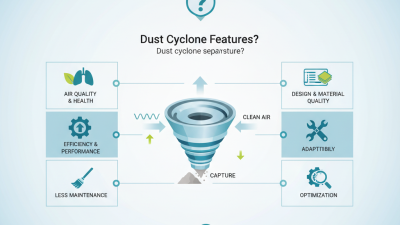
Dust cyclones have evolved significantly in recent years, incorporating advanced technologies to enhance their efficiency. Modern designs feature improved airflow dynamics, allowing for better separation of particles. Research from industry experts indicates that new cyclones can capture over 98% of dust particles, significantly reducing air quality issues in industrial settings. The use of computational fluid dynamics in their design helps optimize space and performance.
Additionally, many dust cyclones are now equipped with
smart sensors. These sensors provide real-time data on performance and maintenance needs, helping operators make informed decisions. This technology improves reliability and reduces downtime, which is crucial for maintaining productivity. Reports suggest that systems with smart integration can reduce operational costs by up to 30%.
However, there are still challenges in the adoption of these technologies. Not every facility has the budget for advanced cyclones, limiting access for smaller companies. Training staff to utilize these systems effectively also remains a barrier. Industry leaders continue to reflect on these issues, seeking innovations that can bridge the gap between advanced technology and practical usability in various work environments.
Market Analysis: Leading Suppliers and Global Demand Trends
The demand for dust cyclone systems is on the rise globally. Recent market analysis indicates a significant shift towards more efficient designs. For instance, studies show that the dust cyclone market is projected to grow at a compound annual growth rate (CAGR) of 5.2% from 2023 to 2028. This growth reflects a broader trend towards cleaner environments and stricter regulations on air quality.
Leading suppliers are adapting to these trends by developing advanced dust cyclone models. These modern systems offer higher separation efficiency. Statistics reveal that over 70% of industrial manufacturers prioritize efficiency to meet compliance standards. However, challenges remain. Some suppliers struggle to keep pace with rapid technological advancements. This can result in delays or compromised product quality.
Moreover, global demand varies by region. For example, the Asia-Pacific market is particularly competitive, driven by industrialization. In contrast, North America shows steady growth due to replacement needs. Such geographic differences highlight the importance of tailored marketing strategies. They also underline the need for suppliers to reflect on their adaptability in a changing landscape.
Guidelines for Selecting the Best Dust Cyclone for Your Needs
When selecting the right dust cyclone, several factors become essential. Efficiency is a primary concern. Studies show that high-efficiency cyclones can remove over 99% of particles. This leads to better air quality. In industrial settings, the need for clean air is crucial. A dust cyclone's design influences its performance significantly.
Another important consideration is the size and type of particles. Some applications require capturing fine dust, while others may focus on larger debris. The American Institute of Chemical Engineers reports that understanding particle sizes helps in choosing a suitable cyclone. Additionally, the airflow capacity must align with your requirements. Mismatching can result in inadequate dust control.
Lastly, maintenance needs cannot be ignored. A cyclone that is easy to clean will save time and costs. Regular maintenance ensures sustained performance. Invest in a model that offers straightforward access to crucial parts. This prevents downtime and enhances efficiency. Reflecting on these factors is vital for making an informed decision.
2026 Best Dust Cyclone for Global Buyers and Suppliers
| Model |
Airflow (CFM) |
Filtration Efficiency (%) |
Dust Capacity (L) |
Noise Level (dB) |
Power (kW) |
Price Range (USD) |
| Model A |
1200 |
99 |
30 |
75 |
3.5 |
800 - 1200 |
| Model B |
1500 |
95 |
40 |
72 |
4.0 |
900 - 1300 |
| Model C |
1000 |
97 |
25 |
70 |
2.5 |
700 - 1000 |
| Model D |
1800 |
99.5 |
50 |
80 |
5.0 |
1100 - 1500 |